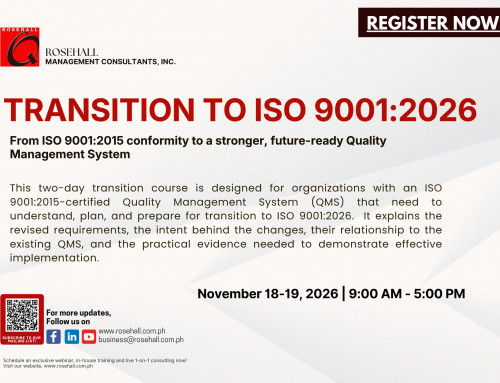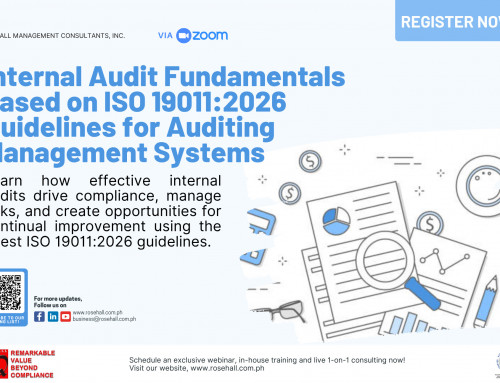


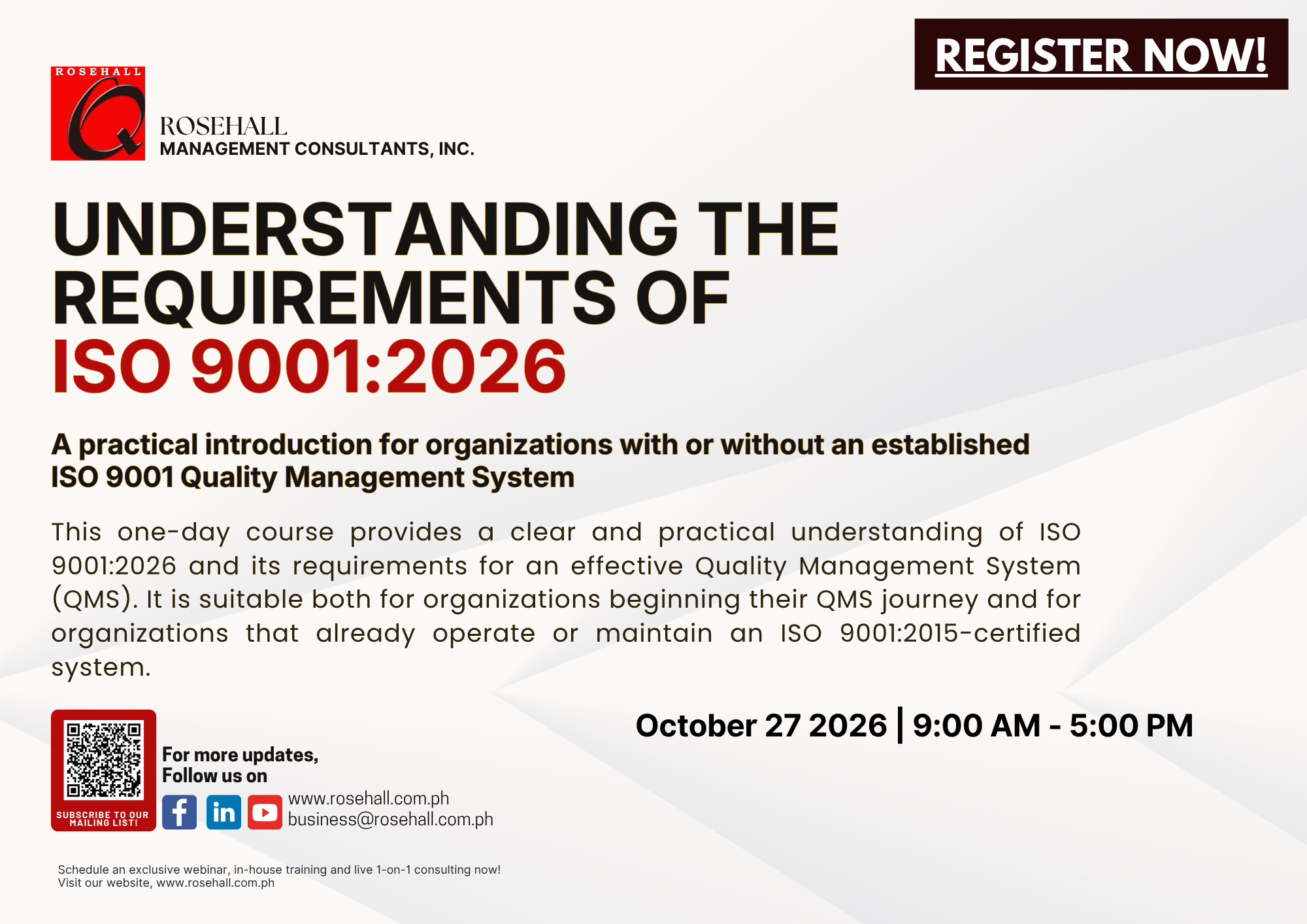
Understanding the requirements of ISO 9001:2026
A practical introduction for organizations with or without an established ISO 9001 Quality Management System
COURSE OBJECTIVES
This one-day course provides a clear and practical understanding of ISO 9001:2026 and its requirements for an effective Quality Management System (QMS). It is suitable both for organizations beginning their QMS journey and for organizations that already operate or maintain an ISO 9001:2015-certified system.
The course explains the purpose and intent of the standard, the seven Quality Management Principles, the process approach and PDCA cycle, risk-based thinking, and the requirements in Clauses 4–10. Participants apply the requirements to realistic organizational situations and complete an initial self-assessment to identify implementation or improvement priorities.
COURSE OBJECTIVES
By the end of the course, participants should be able to:
- Explain what ISO, ISO 9001, and a process-based Quality Management System are—and why organizations establish and maintain a QMS;
- Describe the seven Quality Management Principles and relate them to customer confidence, organizational performance, and strategic direction;
- Explain the process approach, PDCA cycle, risk-based thinking, and their integration within the QMS;
- Interpret the intent and practical application of ISO 9001:2026 Clauses 4–10;
- Identify typical objective evidence that can demonstrate conformity and effective implementation of the requirements;
- Distinguish requirements for documented information from useful practices and avoid unnecessary documentation; and
- Apply the requirements in context, conduct an initial self-assessment, and identify practical next actions for establishing, aligning, transitioning, or improving the QMS.
COURSE CONTENT
MODULE 1. Quality Management and ISO 9001 foundations
- Why establish and maintain a Quality Management System
- What ISO is—and what ISO certification does and does not mean
- Purpose, applicability, structure, and benefits of ISO 9001:2026
- ISO 9000:2026 fundamentals and vocabulary
- The 7 Quality Management Principles
MODULE 2. The QMS framework
- Understanding the organization as a system of interrelated processes
- Process approach, process interactions, inputs, outputs, criteria, resources, responsibilities, risks, opportunities, and performance indicators
- PDCA cycle and risk-based thinking
- Documented information: what is required, what is useful, and what is unnecessary
- Relationship of the QMS to strategic direction and business performance
MODULE 3. ISO 9001:2026 requirements—Clauses 4 to 10
- Clause 4 — Context of the organization: issues, interested parties, scope, and QMS processes
- Clause 5 — Leadership: commitment, customer focus, quality policy, responsibilities, accountability, and quality culture
- Clause 6 — Planning: risks, opportunities, quality objectives, and changes
- Clause 7 — Support: resources, people, infrastructure, process environment, competence, awareness, communication, organizational knowledge, and documented information
- Clause 8 — Operation: customer requirements, design and development, externally provided processes/products/services, production and service provision, release, and nonconforming outputs
- Clause 9 — Performance evaluation: monitoring, measurement, analysis, customer perception, internal audit, and management review
- Clause 10 — Improvement: nonconformity, corrective action, continual improvement, and improved QMS effectiveness
- Annex A clarifications of key terms and the intent of selected requirements
MODULE 4. Requirements application and self-assessment
- Interpreting requirements using organizational context rather than generic checklists
- Identifying objective evidence of conformity and effectiveness for a selected process
- Conducting an initial self-assessment and classifying strengths, gaps, and improvement opportunities
- Workshop 2: Requirements self-assessment using a selected process or current practice
- Preparing initial findings for action planning
MODULE 5. QMS integration, roles, and action planning
- How Clauses 4–10 work together as one process-based QMS
- Roles of top management, process owners, internal auditors, and QMS coordinators
- Priorities for organizations establishing a new QMS
- Priorities for organizations aligning or transitioning an existing QMS
- Post-course knowledge check, action commitments, ownership, and next steps
LEARNING METHODS
- Facilitated explanation in plain language, supported by organizational examples
- Clause-by-clause interpretation focused on intent, application, and objective evidence
- Short knowledge checks and participant reflection
- Small-group context and process application exercise
- Guided requirements self-assessment and action planning
- Separate prompts for organizations establishing a QMS and organizations maintaining or transitioning an existing QMS
PARTICIPANT MATERIALS
- Course handout and presentation materials
- ISO 9001:2026 clause and concept map
- Process characterization worksheet
- Requirements self-assessment worksheet
- Priority action-plan template
- Post-course assessment and certificate of attendance or completion, subject to Rosehall’s applicable course requirements
TARGET PARTICIPANTS
Top executives, senior and middle managers, QMS leaders and coordinators, process owners, internal auditors, documented information controllers, supervisors, team leaders, and employees who will establish, implement, maintain, audit, improve, or transition a Quality Management System.
RECOMMENDED PRE-REQUISITES
No prior ISO 9001 training is required. Participants from organizations with an existing QMS are encouraged to bring or have access to their QMS scope, process map, quality policy and objectives, and selected process information for the application exercises.
SCHEDULE & FEES
For companies with 3 or more participants, please use the group registration form. Send the accomplished registration form to bd@rosehall.com.ph
Upon receipt of your registration, our accounting will send you a statement of account for payment processing. Payments shall be settled before the seminar date.
ACCESS TO WEBINAR LINK WILL BE GIVEN ONLY AFTER PAYMENT IS SETTLED.
CONTACT US

“Learn and Give Back!
When you join ROSEHALL training, you’re not just investing in your skills — you’re helping others, too. A portion of our profits goes to the Rosario Halili Quintos Foundation Inc., funding programs for abandoned elderly and Indigenous Peoples.”