

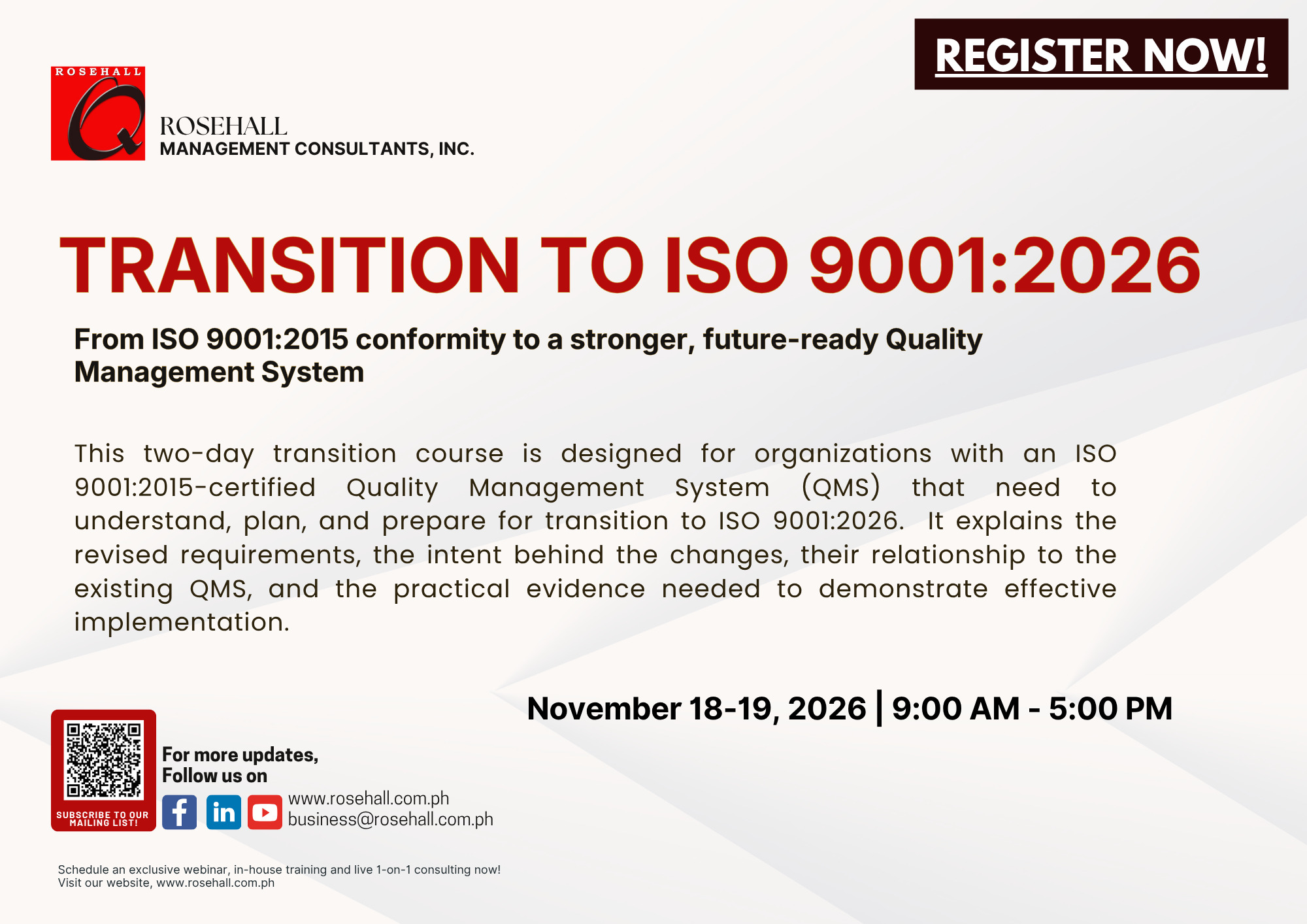
Transition to ISO 9001:2026
From ISO 9001:2015 conformity to a stronger, future-ready Quality Management System
COURSE OBJECTIVES
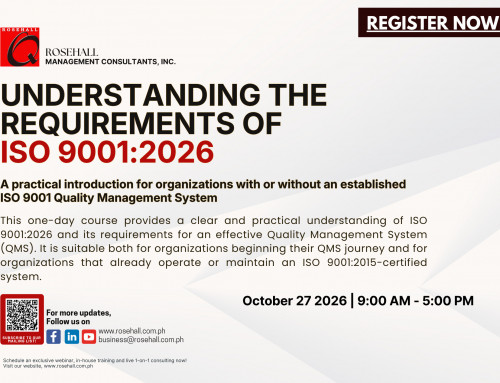
This two-day transition course is designed for organizations with an ISO 9001:2015-certified Quality Management System (QMS) that need to understand, plan, and prepare for transition to ISO 9001:2026. It explains the revised requirements, the intent behind the changes, their relationship to the existing QMS, and the practical evidence needed to demonstrate effective implementation.
The course combines facilitated discussion, clause-by-clause comparison, audit-focused interpretation, and guided workshops. Participants will assess their current system, identify priority gaps, and develop a realistic transition action plan that can be integrated with their certification cycle and organizational priorities.
COURSE OBJECTIVES
By the end of the course, participants should be able to:
- Explain the purpose, development context, structure, and transition implications of ISO 9001:2026;
- Identify the substantive changes and clarifications from ISO 9001:2015, including their intended organizational and audit impact;
- Interpret the revised requirements in the context of the organization’s strategy, processes, risks, opportunities, customers, and interested parties;
- Evaluate the adequacy of the existing QMS through a structured transition gap analysis;
- Determine the documented information, operational practices, performance evidence, and leadership actions that may need to be revised or strengthened;
- Prepare a prioritized transition action plan aligned with the organization’s audit and certification cycle; and
- Communicate the transition requirements and responsibilities to top management, process owners,
internal auditors, and other QMS users.
COURSE CONTENT
MODULE 1. Transition context and architecture
- Why ISO 9001 was revised and what remains fundamentally unchanged
- Status of ISO 9001:2026, official transition arrangements, and coordination with the certification body
- Relationship with ISO 9000:2026 fundamentals and vocabulary
- Revised harmonized structure and closer alignment with other ISO management systemstandards
- Correlation of ISO 9001:2015 and ISO 9001:2026 clauses
MODULE 2. Principal changes and clarified intent
- Clearer requirements and terminology designed to improve consistent understanding and application
- Stronger emphasis on leadership, accountability, and quality culture
- More strategic and explicit treatment of risks and opportunities
- Context, interested parties, and changing business conditions, including climate-related relevance
- Annex A explanations of key terms and the intent of selected requirements
- Implications of technology, digitalization, and organizational knowledge for QMS effectiveness where relevant
MODULE 3. Clause-by-clause transition review
- Clauses 4–5: context, QMS scope and processes, leadership, policy, roles, responsibilities, accountability, and quality culture
- Clause 6: risks, opportunities, objectives, planning of changes, and integration with strategic and operational planning
- Clause 7: people, infrastructure, environment for operations, monitoring resources, competence, awareness, communication, organizational knowledge, and documented information
- Clause 8: operational planning and control; customer and product/service requirements; design and development; external provision; production/service delivery; release; and nonconforming outputs
- Clauses 9–10: monitoring, measurement, analysis, customer perception, internal audit, management review, nonconformity, corrective action, and continual improvement
MODULE 4. Transition implementation and assurance
- Determining what must change—and what does not need unnecessary revision
- Updating the QMS framework, processes, controls, documented information, and performance measures
- Competence, awareness, communication, and change management for transition
- Internal audit and management review for transition readiness
- Coordinating transition timing with surveillance, recertification, and certification-body requirements
- Building and monitoring the organization’s transition action plan
LEARNING METHODS
- Facilitated, clause-by-clause discussion focused on differences, intent, and practical application
- 2015-to-2026 comparison matrices and evidence-based examples
- Case discussions tailored to the client’s sector and existing QMS maturity
- Individual and group exercises using the organization’s current practices where appropriate
- Guided gap analysis and transition action planning
- Knowledge checks, participant reflection, plenary reporting, and facilitator feedback
PARTICIPANT MATERIALS
- Course handout and presentation materials
- ISO 9001:2015-to-ISO 9001:2026 correlation and change summary
- Transition gap-analysis worksheet
- Process and objective-evidence review worksheet
- Transition action-plan template
- Post-course assessment and certificate of attendance or completion, subject to Rosehall’s applicable course requirements
TARGET PARTICIPANTS
Executives, senior and middle managers, QMS leaders and coordinators, process owners, internal auditors, documented information controllers, risk and compliance personnel, and other employees involved in maintaining, auditing, improving, or transitioning an ISO 9001:2015-certified QMS.
RECOMMENDED PRE-REQUISITES
- Working knowledge of ISO 9001:2015 and the organization’s existing QMS
- Access, where practical, to the organization’s QMS scope, process map, quality policy and objectives, risk and opportunity information, recent internal-audit results, and latest management-review outputs
- Participant grouping by function or process to support organization-specific workshop outputs
SCHEDULE & FEES
For companies with 3 or more participants, please use the group registration form. Send the accomplished registration form to bd@rosehall.com.ph
Upon receipt of your registration, our accounting will send you a statement of account for payment processing. Payments shall be settled before the seminar date.
ACCESS TO WEBINAR LINK WILL BE GIVEN ONLY AFTER PAYMENT IS SETTLED.
CONTACT US

“Learn and Give Back!
When you join ROSEHALL training, you’re not just investing in your skills — you’re helping others, too. A portion of our profits goes to the Rosario Halili Quintos Foundation Inc., funding programs for abandoned elderly and Indigenous Peoples.”